
Lynnwood, WA · Garage Door Service
Why Garage Doors in Lynnwood Let in Cold Air and Drafts
Lynnwood homes built between 1965 and 2001 often have worn door seals that let in drafts; see how our climate and housing stock shape the real fix here.
- Repairs & new doors
- Springs & openers
- Serving 6 nearby communities
How Local Conditions Play In
Most of the garage doors we open up around here went in when the house did, and across this service area that means somewhere between 1965 and 2001, with the median sitting at 1988. That's a door old enough that its original bottom seal and side weatherstripping are made from a vinyl compound that was never meant to last fifty years. Across the 35 named areas we work in, the stock is heavy on 1980s and 90s construction, so the same U-channel retainer and the same brittle seal show up house after house.
Our climate band is mild with occasional freeze, not the deep-cold conditions that split rubber overnight. That actually works against you in a quieter way: instead of one hard freeze cracking a seal all at once, repeated mild freeze-thaw cycles work moisture into rubber that's already drying out, and the seal loosens from the track a little more each winter. You don't get a dramatic failure. You get a draft along the bottom edge that creeps in over a few seasons until you finally notice the cold spot by the washer and dryer.
The Cost of This Job
A seal and weatherstripping job is one of the cheaper repairs we do, and most of what drives the price is the door's age and hardware, not labor time. On a door built in the 1988-era range that's common here, we're usually dealing with a standard aluminum retainer track, which keeps things simple. Doors from different manufacturers or custom sizes can need a seal cut to spec, which adds a little.
We don't quote a flat number over the phone because retainer tracks on older doors are sometimes bent or rusted at the corners, and that's a different job than a clean seal swap. What we can tell you is that this is not a job where paying more buys you much - a correctly sized seal in the right retainer does the work, full stop. With median household income in this area over $128,000, we see plenty of owners who could replace the whole door but choose to reseal a 30-year-old one instead, because the door itself is still sound. That's usually the right call.
The Problem
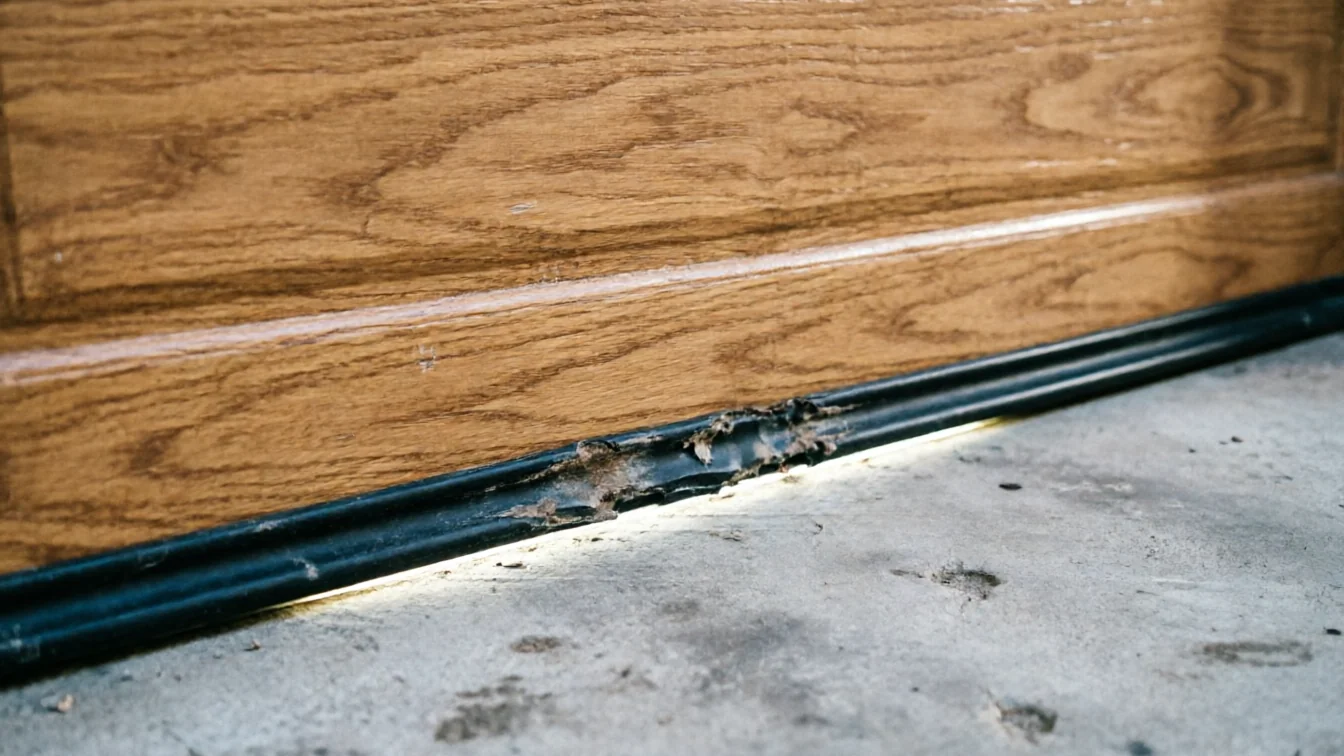
Open the garage door and look at the bottom edge where it meets the slab. On a door from the 1965-2001 era that's common in this area, you'll often find the seal has pulled away from the aluminum retainer on one or both ends, or it's gone flat and lost its bulb shape entirely. That flattening is what lets air through even when the door looks closed and sealed.
Side seals get less attention and fail just as often. The vinyl strip stapled or screwed along the jamb hardens with age, shrinks slightly, and pulls away from the frame at the top corners first - which is exactly where cold air finds its way in around a garage that backs onto a bedroom or laundry room, a common layout in the 1980s and 90s construction that makes up most of this stock.
We also see top seals ignored completely. A lot of owners don't realize there's supposed to be a seal along the header at all, so when it's missing or crumbled, nobody replaces it because nobody knew it was there to begin with.
Leaving It Alone
A worn-out seal doesn't fail your door. It fails your utility bill and your garage floor. Drafts through a flattened bottom seal pull conditioned air out of an attached garage steadily, and if there's a bedroom or living space on the other side of that wall, you'll feel it as a cold patch that no amount of thermostat adjusting fixes.
The bigger issue is water. A seal that's pulled off its retainer stops doing its other job, which is keeping runoff and snowmelt outside the slab line. On the older doors common across this area, water that gets under the door track over a few winters starts rusting the bottom panel from the inside, which is a panel replacement instead of a ten-minute seal swap. We'd rather fix the cheap part now than replace the expensive part later.
Frequently asked questions
How do I know if my garage door seal needs replacing or just cleaning?
If the seal is flat, cracked, or pulling away from its track along any edge, cleaning won't fix it - the rubber has lost its shape and won't bulb back out to close the gap. If it's just dirty or a little stiff, a wipe-down and some silicone-based conditioner can buy you more time.
Why does my garage feel drafty even though the door looks fully closed?
A door can look shut while the bottom seal has flattened or pulled off the retainer, leaving a gap you can't see from a few feet away. This is common on older doors in this area built before more recent seal designs, and it's usually fixed with a seal swap, not a new door.
Does Lynnwood's climate make seals wear out faster?
Not from extreme cold - our climate is mild with only occasional freeze. But repeated freeze-thaw cycles work moisture into rubber that's already aging, so seals here tend to loosen gradually over several winters rather than crack suddenly.
Related garage door services in Lynnwood
More garage door guides
Book garage door service in Lynnwood
Call now or request a quote - tell us what the door is doing and where you are.